


Protecting Solar Farm Wiring in Southeast Asia's Tropical Climate: UL Listed PVC Non-metallic Mechanical Protection Tubing (NMPT) Case Study
Protecting Solar Farm Wiring in Southeast Asia's Tropical Climate: PVC Non-metallic Mechanical Protection Tubing (NMPT) Case Study
Project Background
Ground-mounted utility-scale solar photovoltaic (PV) installations across Southeast Asia — including projects in Vietnam, Thailand, and Indonesia — have expanded rapidly in recent years, driven by aggressive national renewable energy targets and falling panel costs. These installations typically range from 50 MW to 500 MW in capacity, covering vast areas of open land where thousands of string inverters, combiner boxes, and DC distribution panels must be interconnected with reliable, long-lasting electrical protection systems.
Unlike rooftop or commercial PV installations, ground-mounted solar farms present a uniquely demanding set of environmental conditions for conduit and cable protection products. Selecting the wrong conduit system in this environment does not just cause maintenance headaches — it can lead to ground faults, arc events, and unplanned downtime that directly erodes the project's 25-year return on investment.
Environmental Challenges
Southeast Asia's tropical climate creates four simultaneous stress conditions that any conduit system must address:
1. Extreme UV Radiation
Equatorial and near-equatorial locations receive solar irradiance levels of 1,600 to 2,000 kWh/m² per year. Conduit installed outdoors on cable trays, along racking structures, or buried in shallow trenches is exposed to continuous UV radiation for 25+ years — the designed service life of the PV plant. Standard PVC conduit without UV stabilization becomes brittle, discolored, and prone to cracking within 3 to 5 years under these conditions, exposing conductors to environmental ingress.
2. Monsoon Rainfall and Flooding
The monsoon season across Vietnam, Thailand, and Indonesia brings sustained heavy rainfall from May through October, with peak daily rainfall exceeding 200mm in some regions. Cable trenches and conduit runs at ground level are routinely submerged during storm events. A conduit system rated only to IP65 or IP66 may allow water ingress under sustained immersion — a failure mode that is particularly damaging for DC string wiring operating at 600V to 1,500V.
3. High Ambient Humidity and Condensation
Even outside the monsoon season, ambient relative humidity routinely exceeds 80–90% in coastal and inland tropical areas. Metallic conduit systems, even when galvanized, are subject to corrosion at cut ends, fitting interfaces, and mechanical damage points, requiring ongoing inspection and maintenance over a multi-decade project life.
4. Soil Acidity and Chemical Exposure
Many ground-mounted solar sites in the region are developed on former agricultural land with acidic soils, or near coastal areas with salt-laden groundwater. Direct-buried conduit sections must resist chemical attack from both soil contact and fertilizer residues.
Product Selection: PLFNCB2 PVC Liquid-tight Non-metallic Flexible Conduit
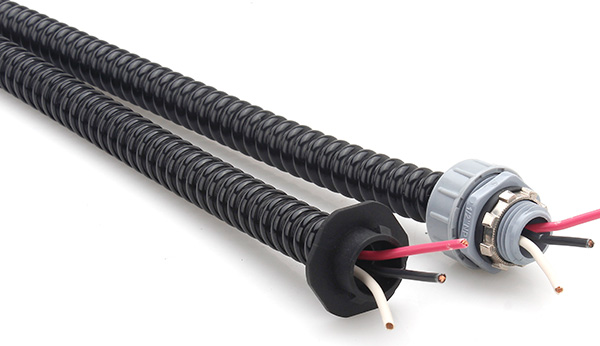
After evaluating the site conditions against available conduit solutions, the Kaiflex PLFNCB2 series — a cURus-listed PVC Non-metallic Mechanical Protection Tubing (NMPT) — was selected as the primary conduit solution for the inverter-to-combiner box wiring segments and above-ground cable management runs.
The selection was based on four specific technical criteria:
1. IP68 Ingress Protection Rating
The PLFNCB2, when used with Kaiflex P50 (straight) or P53 (90° elbow) fittings, achieves an IP68 system rating — complete dust-tight protection and resistance to continuous water immersion beyond 1 meter depth. This exceeds the IP65 minimum commonly specified in tropical solar projects and provides a meaningful safety margin during flood events, where conduit sections at grade may be submerged for extended periods during severe weather.
2. UV Stabilization and Long-term Outdoor Durability
The PLFNCB2's thermoplastic PVC jacket incorporates UV-stabilizing additives that resist photodegradation under prolonged solar exposure. This is a critical requirement for conduit installed on above-ground cable tray systems running between inverter pads and medium-voltage transformer stations — sections that receive full-day direct sun exposure throughout the plant's 25-year operational life.
3. Inherent Corrosion Resistance — Non-metallic Construction
Because the PLFNCB2 is fully non-metallic, it requires no surface coating, galvanization, or corrosion inhibitor to maintain its structural integrity in contact with acidic soil, salt-laden air, or standing water. There is no rust, no coating degradation, and no galvanic corrosion risk at fitting interfaces — maintenance factors that significantly reduce the total lifecycle cost of the conduit system compared to metallic alternatives on a 25-year horizon.
4. cURus Certification (UL File No. E505697)
The PLFNCB2 PVC Non-metallic Mechanical Protection Tubing (NMPT) carries cURus listing under UL File No. E505697, certified per UL 1696 and CSA 22.2 No. 227.3. For projects seeking financing from international development banks or export credit agencies — a common structure for large-scale Southeast Asian solar projects — UL-listed electrical components support compliance documentation requirements and facilitate project insurance and lender technical due diligence reviews.
Application Details
The PLFNCB2 was deployed across three wiring zones within the solar farm:
1. Zone 1 — String Inverter Output to DC Combiner Boxes (Above Ground)
Trade sizes 1/2" (metric 16) and 3/4" (metric 21) were used for short-run wiring between string inverters mounted on racking structures and nearby DC combiner boxes. The high flexibility of the PLFNCB2 (rated high for all sizes) enabled clean routing around racking members and tilt frames without additional support hardware, reducing installation labor time per connection point.
2. Zone 2 — AC Output Wiring at Inverter Pads (Grade Level)
Trade sizes 1" (metric 27) and 1-1/4" (metric 35) were used for AC output connections between central inverters and low-voltage switchgear at the inverter pad. These runs are exposed to potential pooling water at grade level during heavy rainfall. The IP68 system rating — achieved with Kaiflex P50 fittings — provided the project EPC contractor with confidence that water ingress would not compromise insulation resistance on these high-current AC conductors.
3. Zone 3 — Monitoring and Communication Cable Protection (Direct-buried Sections)
Trade size 1/2" (metric 16) PLFNCB2 was used for shallow-buried protection of SCADA communication cables and irradiance sensor wiring. The non-metallic construction eliminated the need for corrosion assessment at burial depth, and the smooth inner bore facilitated clean cable pull-through without snagging or abrasion damage to the cable jacket.
Installation Notes
The PLFNCB2's lightweight construction and compatibility with standard PVC cutting tools significantly reduced per-unit installation time compared to metallic conduit alternatives. No threading equipment, deburring tools, or corrosion-protection treatment at cut ends was required. Fittings from the Kaiflex P50 and PP60 series were installed by hand without specialist tooling, achieving the IP68 system rating through a compression seal mechanism that does not rely on thread sealant compounds — a common source of inconsistency in field installation quality.
Operating temperature range of -18°C to +80°C is comfortably within the thermal range of Southeast Asian ambient conditions, including the elevated temperatures experienced inside inverter enclosure entry points where conduit interfaces with electrical equipment.
Outcome
The use of PLFNCB2 non-metallic flexible conduit across the solar farm's conduit-protected wiring segments delivered measurable benefits across the project lifecycle:
• Zero corrosion-related failures in above-ground and grade-level conduit runs through the first two monsoon seasons following commissioning, compared to reported surface oxidation issues observed in galvanized metallic conduit used in an adjacent project section during the same period.
• Reduced inspection frequency — the non-metallic system requires no periodic corrosion inspection, reducing O&M overhead relative to metallic conduit systems in the same environment.
• Faster installation — EPC contractor site teams reported approximately 30% reduction in conduit installation time per connection point versus rigid metallic conduit with threaded fittings, attributable to lightweight handling, no threading requirement, and tool-free fitting assembly.
• Full IP68 system compliance documented through fitting manufacturer certification, supporting project insurance underwriting and lender technical audit requirements.
Conclusion
Tropical solar farms in Southeast Asia impose a demanding combination of UV exposure, monsoon flooding, sustained humidity, and soil chemistry that eliminates many conventional conduit options over a 25-year project horizon. The Kaiflex PLFNCB2 non-metallic flexible conduit — with its IP68 system rating, UV-stabilized PVC jacket, fully non-metallic corrosion-resistant construction, and cURus listing — addresses each of these failure modes in a single product, reducing both initial specification risk and long-term O&M burden for solar EPC contractors and asset owners operating in the region.
Products referenced in this case:
• PLFNCB2 PVC Non-metallic Mechanical Protection Tubing (NMPT)
• P50 — IP68 Straight Liquid Tight Non-metallic Fitting
• P53 — IP68 90° Elbow Liquid Tight Non-metallic Fitting

Looking for high-fit metal or non-metal conduits and fittings?